


Tupac Murder Trial Begins as Keefe D Faces Court Nearly 30 Years After Rapper’s Death
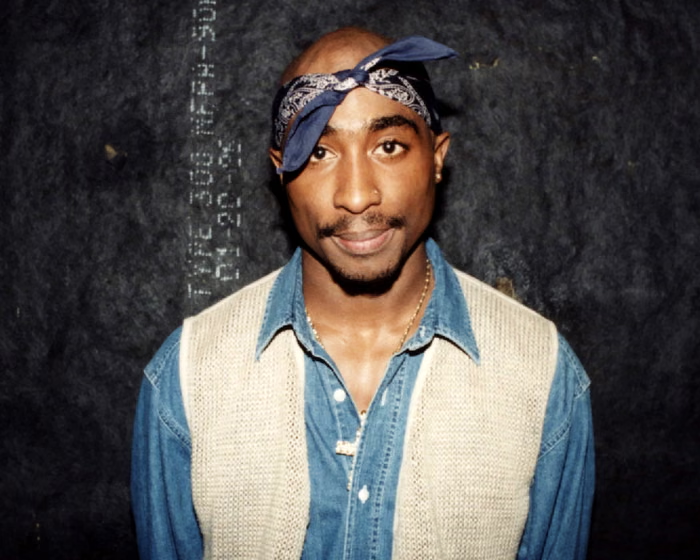
Nearly 30 years after the death of Tupac Shakur, one of the most closely watched cases in hip-hop history has finally entered a courtroom.
Jury selection began Monday, August 10, in Las Vegas for the murder trial of Duane “Keffe D” Davis, the former Compton gang member accused of orchestrating the 1996 killing of the legendary rapper. Davis has pleaded not guilty to the charge, and the proceedings are expected to last approximately four to five weeks.
The case represents a major moment not only for Tupac’s family but also for West Coast hip-hop. Shakur was one of the defining artists of the 1990s West Coast rap movement, and his death became one of the most enduring mysteries in music history.
Jury Selection Begins in Las Vegas
The first major stage of the trial began with potential jurors being questioned about their knowledge of Tupac’s murder, the decades-long investigation and information they may have encountered through news coverage or social media.
According to local reporting, prosecutors and defense attorneys have been carefully examining potential jurors to determine whether they can approach the case without being influenced by the enormous amount of public discussion surrounding Tupac’s death.
The intense public interest presents an unusual challenge for the court. Tupac’s murder has been discussed for decades through documentaries, books, interviews, music, podcasts and countless online theories. That history means many potential jurors are likely to have encountered competing accounts of what happened.
By the end of the second day of jury selection, 15 prospective jurors had advanced to the next stage of the process.
Once a full jury is selected, prosecutors and Davis’ defense team will move toward opening arguments and the presentation of evidence.
What Is Keefe D Accused Of?
Davis is charged in connection with the September 1996 shooting that killed Tupac Shakur in Las Vegas.
Prosecutors allege that Davis played a central role in organizing the attack. The case has its roots in an altercation earlier that night at the MGM Grand involving Tupac and members of a group associated with the South Side Compton Crips.
Hours later, Tupac was riding in a BMW driven by Death Row Records co-founder Marion “Suge” Knight when another vehicle pulled alongside them at a Las Vegas intersection. Gunfire erupted, striking Tupac multiple times and also injuring Knight.
Tupac was taken to a Las Vegas hospital but died six days later at the age of 25.
For decades, the identity of the people responsible remained the subject of intense speculation. Davis became the only person charged in the case after Las Vegas police arrested him in September 2023, nearly 27 years after the shooting.
He has maintained his not-guilty plea.
Why the Case Matters to West Coast Hip-Hop
The Tupac murder trial is much bigger than a criminal case involving a single rapper.
Tupac Shakur became one of the central figures of West Coast hip-hop during the 1990s. His relationship with Death Row Records, his connection to Los Angeles and his highly publicized rivalry with artists associated with the East Coast made him an important figure in one of hip-hop’s most influential eras.
His death also came at the height of the East Coast-West Coast rap conflict.
Tupac had moved to Los Angeles and signed with Death Row Records after leaving prison in 1995. During his time with the label, he released some of his most successful work and became closely associated with the West Coast sound and culture.
His 1996 album All Eyez on Me remains one of the landmark releases of the era.
Because of that history, developments inside a Las Vegas courtroom are being watched closely by fans who have followed the case since the night Tupac was shot.
The Evidence and Davis’ Own Past Statements
One of the most significant elements expected to feature in the case is Davis’ history of speaking publicly about Tupac’s death.
Davis has discussed the shooting and his alleged involvement in various interviews and in his memoir. Prosecutors are expected to use some of those statements as part of their case.
The defense, however, has challenged aspects of how those statements should be interpreted and has argued that Davis’ words do not establish that he committed the crime charged.
A jail call has also become part of the legal battle surrounding Davis’ statements and his memoir. Reports indicate prosecutors and defense attorneys have disputed the circumstances surrounding the book and what Davis actually authored or said about the events.
That makes the question of Davis’ own words potentially important as the trial moves beyond jury selection.
Suge Knight and the Wider Tupac Story
The trial is also generating renewed attention around people who were close to Tupac during his final days.
Suge Knight, who was driving the vehicle when Tupac was shot, has recently spoken publicly about the case. Knight has warned against being unnecessarily pulled into the proceedings while also suggesting that the circumstances surrounding Tupac’s death involved more people than Davis alone.
Knight’s comments are likely to generate further discussion among hip-hop fans, but they should be separated from evidence formally presented in court.
The trial itself will ultimately be determined by the evidence admitted by the judge and the verdict reached by the jury.
A Mystery That Has Lasted Nearly Three Decades
Tupac was killed on September 7, 1996, but the questions surrounding his death never disappeared.
For years, theories about the shooting circulated throughout hip-hop. The case became part of the mythology surrounding Tupac, with fans, journalists and investigators examining everything from the events at the MGM Grand to the people who were with him during his final hours.
The 2023 arrest of Davis changed the case dramatically.
After years without an arrest, authorities finally charged someone they believed could be held responsible for the killing. Davis has since remained in custody while the case moved through a series of legal delays and changes involving his defense team.
The trial was eventually scheduled for August 10, 2026, bringing the case to its current stage.
What Happens Next?
The immediate focus remains on completing jury selection.
Once the jury is seated, the court will hear the prosecution and defense cases. The proceedings are expected to last around a month or potentially five weeks, although the exact timeline could change depending on the evidence and legal arguments presented in court.
One of the biggest questions surrounding the trial is whether Davis himself will testify. A former Clark County district attorney who has discussed the case publicly suggested that Davis is unlikely to take the stand, although the final decision belongs to his defense team.
The court will also have to deal with evidence accumulated over decades, including statements, interviews and other material connected to the investigation.
Tupac’s Legacy Remains Bigger Than the Case
Regardless of what happens in court, Tupac Shakur’s influence on hip-hop is unlikely to change.
His music continues to introduce new generations to the realities, contradictions and struggles that shaped his career. His work addressed poverty, violence, relationships, racism, ambition and life on the streets while also showing his ability to become a commercially successful superstar.
For West Coast hip-hop, his legacy remains particularly significant.
The trial now offers the possibility of answers in a case that has remained unresolved for almost 30 years. But for Tupac’s family, fans and the wider hip-hop community, the proceedings are also a reminder of how much time has passed since one of rap’s most influential voices was silenced.
As jury selection continues in Las Vegas, the world is once again watching the Tupac Shakur murder case. This time, however, the questions that have surrounded his death for nearly three decades will be examined inside a courtroom, where a jury will ultimately decide whether prosecutors have proved their case against Duane “Keffe D” Davis beyond a reasonable doubt.